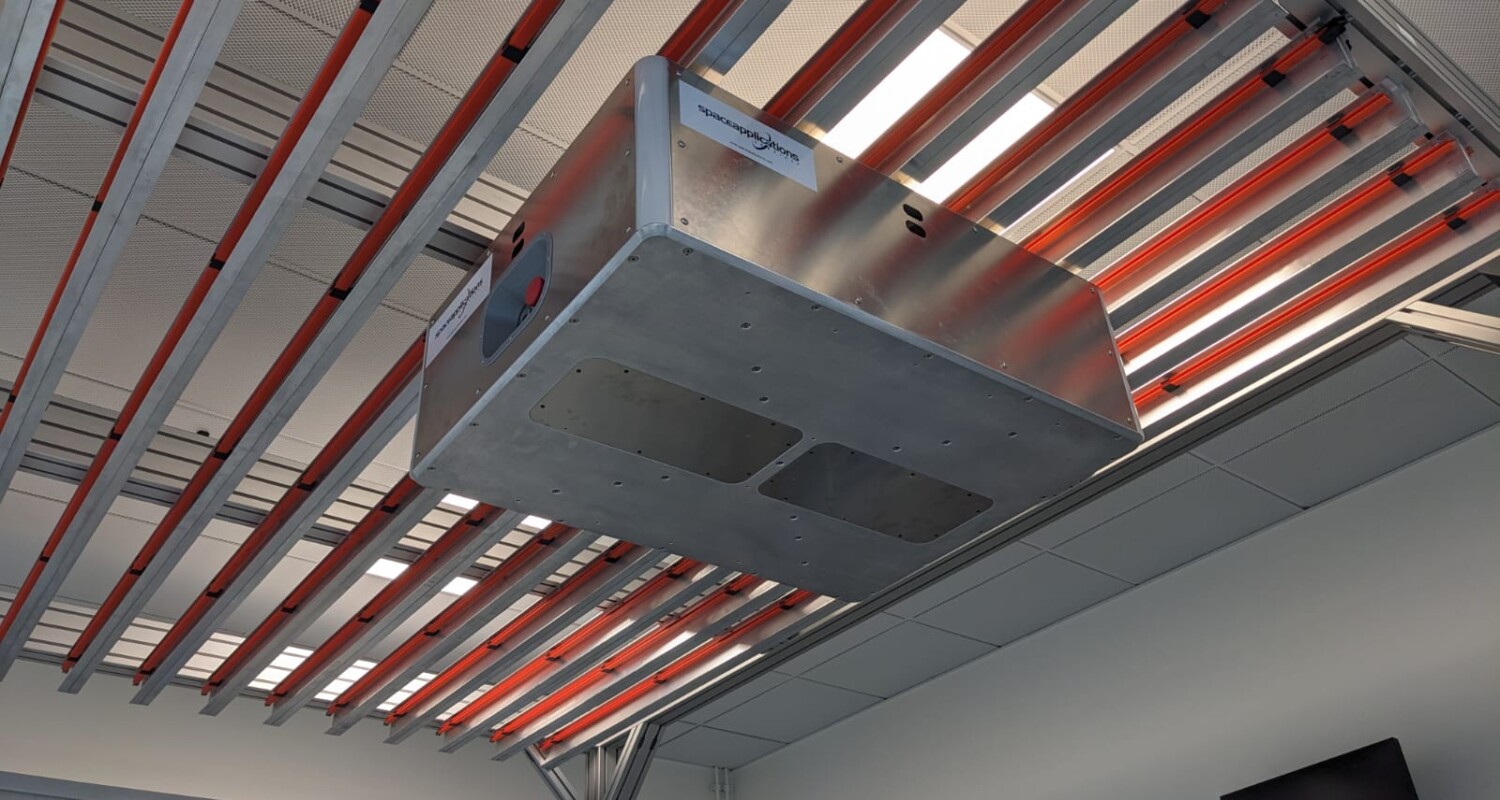
The Overhead Mobility Vehicle is a novel overhead locomotion technology that offers unprecedented mobility & scalability. The technology allows multiple, omnidirectional vehicles suspended on a ceiling structure to operate freely next to each other.
-
Cranes allow reaching every point in their workspace. However, operations are highly constrained and for instance, do not allow for any vertical interruption (like a pillar). Also, the number and mobility of parallel-operating cranes are highly constrained by their kinematics.
In contrast, overhead conveyors allow multiple transport units to operate close to each other. However, conveyors follow a predefined track and thus are also limited in mobility.
The Overhead Mobility Vehicle (OMV) combines the benefits of traditional overhead operation systems such as cranes and overhead conveyors while minimizing constraints on motion and workspace.
Locomotion Mechanism
OMV’s locomotion system uses a caterpillar-like mechanism that is modified to mechanically interact with a special ceiling structure. This novel locomotion technology enables a vehicle to traverse the ceiling structure in all directions (omnidirectional) and hence can reach every point in the workspace.
The locomotion system uses a Form-Fit connection to interact with the ceiling structure. By design, this connection allows for high load capacity (up to tons range) combined with a great level of safety.
OMV exists in passive and active versions. The active one relies on Omni-wheels to enable side motion, which combined with the track motion, allows for omnidirectional active motion. Active Ceilix vehicles can be battery-powered, or draw power from power lines embedded in the ceiling structure.
-
Overhead mobility for on-board logisticsSpace Applications Services is extending its overhead mobility system for use on board naval vessels. Several compact vehicles drive independently on a modular ceiling structure, so equipment, spares and supplies can be moved in any direction in compartments where conventional handling equipment struggles.Typical use on board
-
Mission bays and modular payload handling
-
Logistics, storage and provision rooms
-
Workshops and maintenance areas
Why omni directional overhead mobility?-
Several loads at once: multiple vehicles operate side by side instead of a single hoist serving the whole space.
-
Full coverage: omnidirectional travel reaches every point and works around pillars, piping and cable trays.
-
Compact installation: a flat ceiling structure, with no runway beams or bridge.
-
Cooperative handling: vehicles can share heavy or bulky loads or rotate them in place.
-
Scalable, across decks: a tile-based ceiling fits irregular compartments and can be extended or reconfigured later. A tile can also act as a lift, carrying a vehicle and its load to another deck without unloading.
Designed for the maritime environmentThe maritime version adds braking and load-securing for operation in a seaway and is being developed with classification-society certification in mind. A demonstrator for testing under simulated sea-state conditions is in preparation. -
-
Overhead Mobility Vehicle Features
Multi-Vehicle Application Heterogenic Vehicle Usage Cooperative Operations (Increased Payload) Cooperative Operations (Change Orientation) ✓ ✓ ✓ ✓