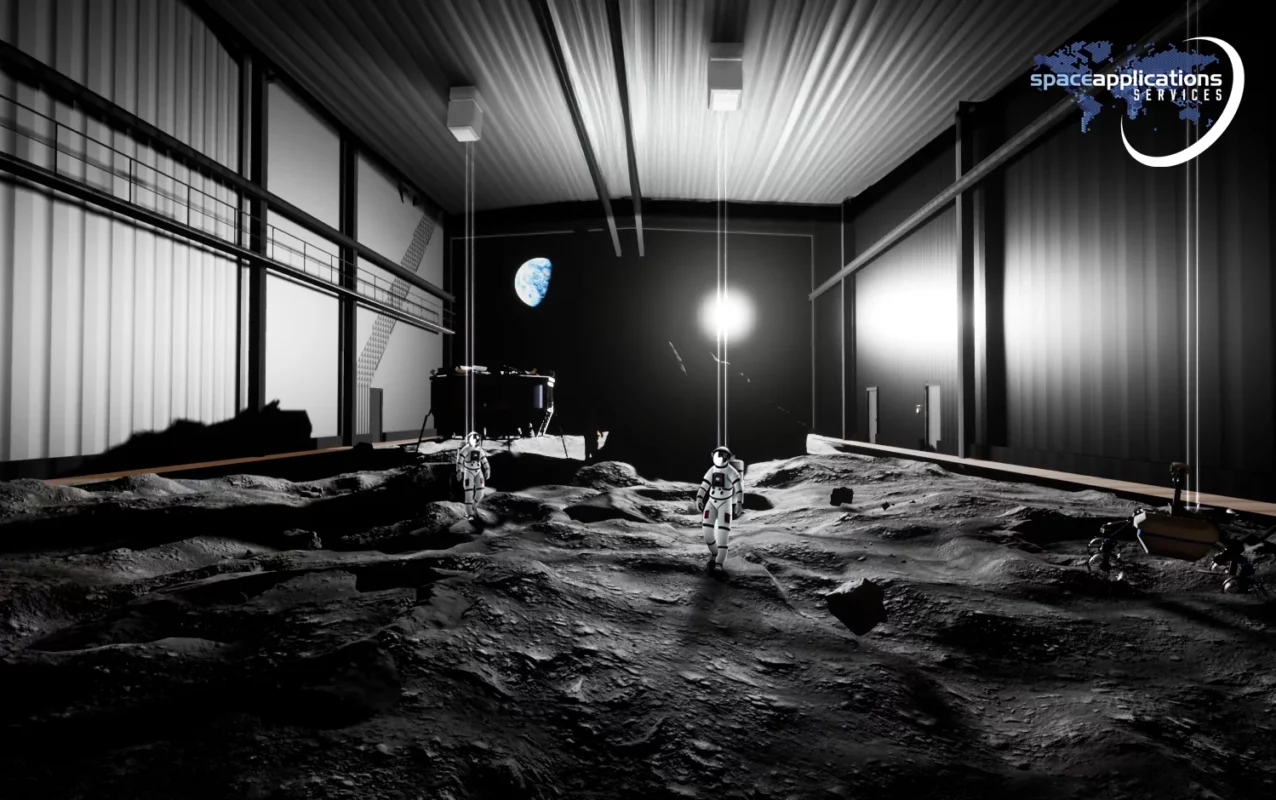
Zaventem, Belgium / Cologne, Germany, 06/10/2026 – Space Applications Services is proud to announce the successful completion of Phase 1 of the PUPPETEER project, marked by the delivery, installation, and commissioning of its proprietary Mobile Gravity Off-loading System (MOGOS) at LUNA, the analogue facility developed by the German Aerospace Center (DLR) and the European Space Agency (ESA) in Cologne, Germany.
The milestone represents a major step forward in preparing astronauts, technologies, and operational concepts for future lunar exploration missions within LUNA facilities. By compensating for five-sixths of a person’s weight, the Mobile Gravity Off-loading System enables users to experience movement under lunar gravity conditions, equivalent to approximately one-sixth of Earth’s gravity.
Installed in a partnership with ESA and DLR within LUNA’s lunar analogue environment, the system will allow astronauts to train for activities they will perform on the Moon, including walking, traversing uneven terrain, operating equipment, and executing mission procedures under realistic gravitational conditions. The facility will also support the testing and validation of scientific payloads, instruments, robotics, and exploration technologies before deployment to future lunar missions.
“The successful delivery and installation of the Phase 1 Mobile Gravity Off-loading System (MOGOS proprietary product) at LUNA is an important achievement for our company and a significant contribution to Europe’s lunar exploration ambitions, while underlining our unrivalled expertise in low gravity and offloading systems,” said Jeremi Gancet, Systems Department Manager at Space Applications Services. “By enabling realistic simulation of lunar gravity in a highly representative and scalable environment, the system will help astronauts, engineers, and researchers better prepare for the operational challenges of working on the Moon. We are proud to see our technology selected by DLR and becoming part of such a strategic facility for future exploration. We are looking forward to the next phases of the partnership program.”
“The completion of Phase 1 is a major milestone for LUNA and for everyone who has worked to make this system a reality. For many years, we have been working towards bringing high-fidelity lunar gravity simulation to Earth, and seeing the Phase 1 system now installed and operational in LUNA is a hugely rewarding moment.” Added Wafa Sadri, DLR’s System Engineer for the LUNA Facility. “This is only the beginning. We will now use Phase 1 to put the system through an extensive testing campaign, allowing us to build experience, validate its performance and learn how to operate it effectively in the LUNA environment. These lessons will be essential as we move towards Phase 2, where we intend to expand the system for multi-user applications across the entire LUNA analogue surface. Getting to this point has been a long engineering journey, filled with first-of-a-kind challenges and complex requirements that demanded innovative and elegant solutions. What we have achieved is, in my view, a truly remarkable piece of engineering. I’m incredibly proud of what the team has accomplished, and I’m excited to see how we can build on this foundation in Phase 2.”
Bringing the Moon Closer to Earth
LUNA is a state-of-the-art analogue facility jointly developed by DLR and ESA to prepare astronauts, technologies, and operational concepts for future lunar exploration missions. Combining a realistic lunar terrain environment with advanced simulation capabilities, the facility provides a unique platform for astronaut training, scientific research, and technology validation.
With the integration of the Mobile Gravity Off-loading System (MOGOS), a proprietary product from Space Applications Services, LUNA will simulate the Moon’s one-sixth gravity, allowing astronauts to train in conditions that closely resemble those they will encounter on the lunar surface. The system, scalable and multi-dimensional, supports the development and validation of mobility techniques, surface operations, and mission procedures, while also enabling the testing of technologies and payloads destined for future Moon missions.
As ESA prepares for a sustained European presence on the Moon, capabilities such as the Mobile Gravity Off-loading System are essential to reducing mission risk and improving mission readiness. By enabling realistic lunar gravity simulations on Earth, LUNA and MOGOS help ensure that astronauts, operational concepts, and exploration technologies are ready for the challenges of future lunar surface missions. Through this enhanced capability, Europe strengthens its role in supporting the next generation of human exploration beyond Earth.
Press & Media contact
Maxime Goffinet
Communications & Media Coordinator
Space Applications Services NV/SA
maxime.goffinet@spaceapplications.com
+32477757614