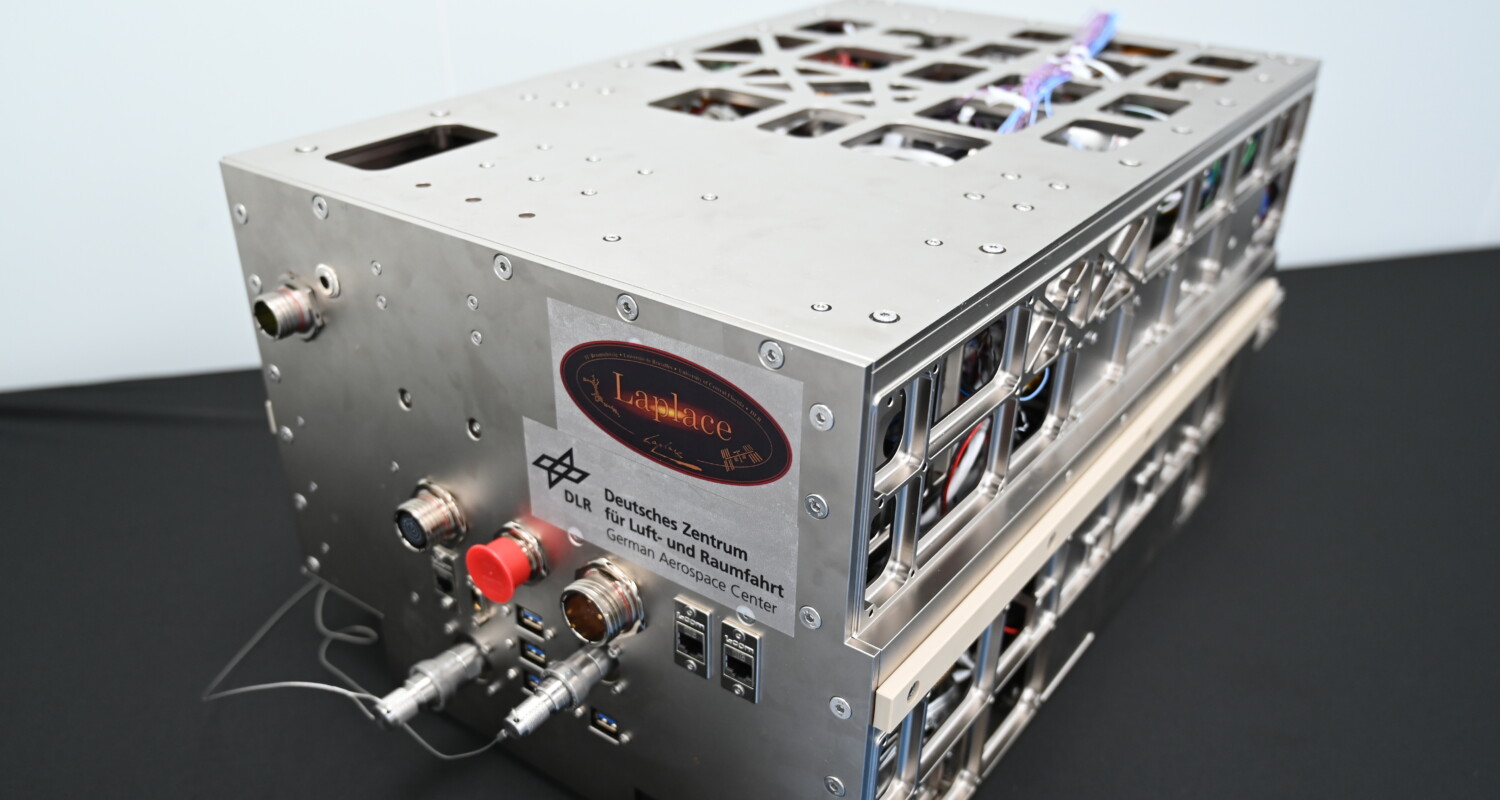
Advancing our understanding of how planets are born
Laplace is a state-of-the-art microgravity research facility designed to investigate the earliest stages of the Solar System’s formation. The experiment focuses on how microscopic dust particles interact and grow into larger bodies—including asteroids, comets, and planetesimals—over time.
By recreating the conditions of a protoplanetary disk, Laplace enables scientists to study how these particles evolve from micrometer-scale grains into kilometre-scale objects, providing key insights into one of the fundamental processes shaping planetary systems.
Recreating cosmic conditions in microgravity
In the Laplace experiment, a cloud of microscopic dust particles is introduced into a low-density residual gas atmosphere, simulating the environment of the early Solar System. In the absence of gravity-driven disturbances, particles are free to move and interact naturally.
Advanced instruments allow scientists to observe the dust cloud in three dimensions, track aggregation processes in real time, and measure key parameters such as particle charge distribution and light extinction. This enables the detailed study of particle growth mechanisms and interaction dynamics over extended periods—something only possible in a microgravity environment.
A European-led scientific collaboration
Laplace is carried out on behalf of the German Space Agency at DLR (Bonn) and funded by the Federal Ministry for Economic Affairs and Energy (BMWi).
The project is conducted under the scientific leadership of the Technical University of Braunschweig (Germany), with contributions from the Université Libre de Bruxelles (Belgium), the University of Central Florida (USA), and Space Applications Services (Belgium).
Since the project’s inception in 2021, Space Applications Services has acted as prime contractor, responsible for the adaptation and integration of the facility for operation on the ISS. The experiment builds upon previous findings from the ICAPS missions, further advancing research into dust agglomeration under microgravity conditions.
A key milestone for space science and industry
The successful activation of Laplace represents a significant achievement for all partners involved and highlights the strength of international collaboration in advancing fundamental space research.
Mauro Ricci, Team Lead – ICE Cubes Strategic Unit at Space Applications Services, commented:
“This is a real milestone for our service. Laplace cannot be classified as a ‘cube’. It is a medium-size payload with a volume of 64 litres, a mass of 55 kg and a power demand of about 300 W. It has nitrogen and vacuum connections directly to the Columbus module. This demonstrates the capability of the multipurpose ICE Cubes Facility to go well beyond the concept of serving ‘small cubes’. We are ready for bigger payloads.”
By unlocking new knowledge about the origins of planetary systems, Laplace contributes not only to our understanding of the Solar System but also to the study of exoplanetary systems across the universe.