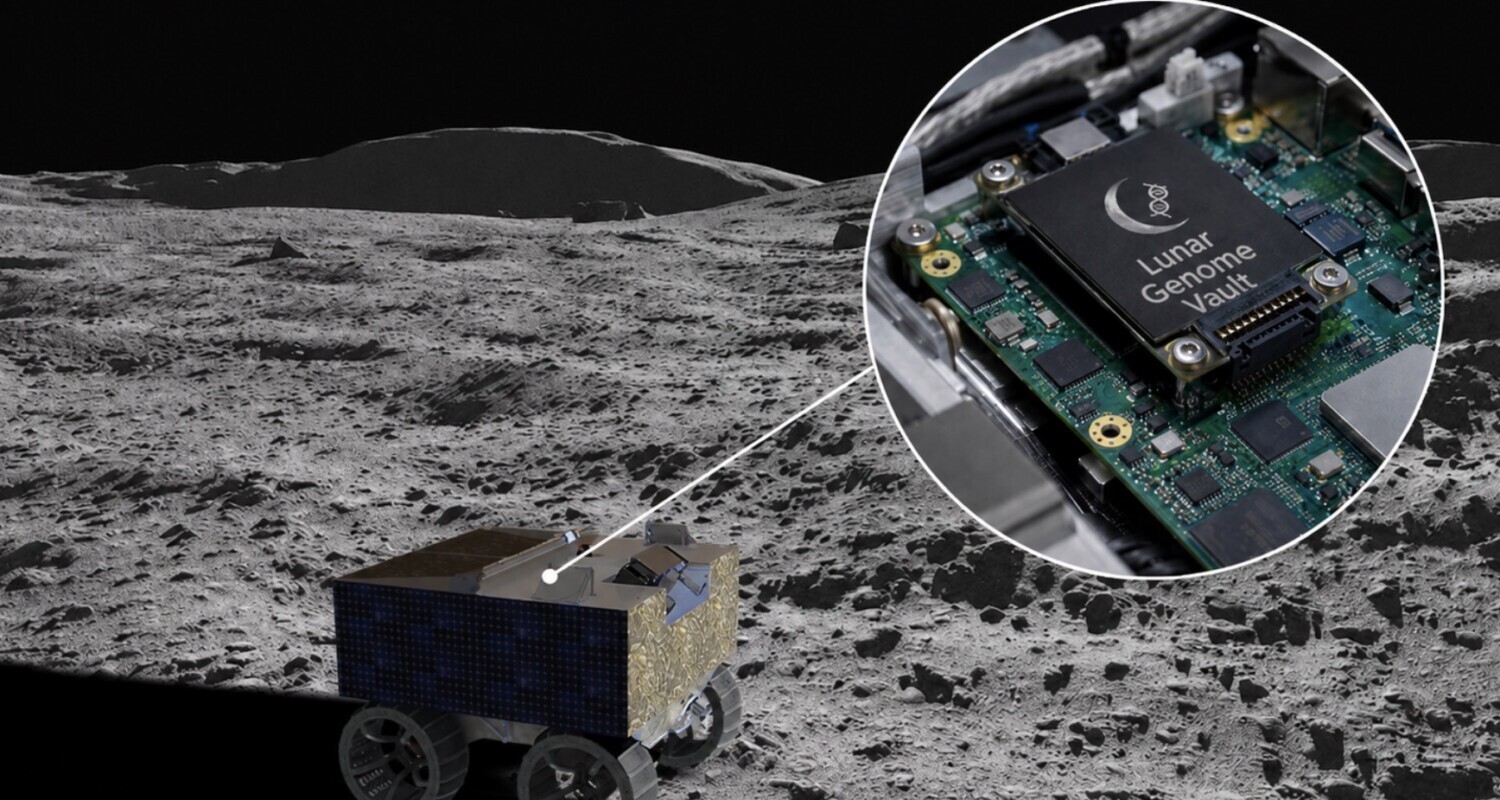
The initiative, titled the Lunar BioVault, will serve as a long-term, scientific digital archive, a curated repository designed to carry messages, educational content, scientific records that include the whole genome sequence data archive of all known life known to Earth, as well as inspirational contributions from Malta, US, and international partners towards the lunar surface.The Lunar BioVault is intended to represent more than data storage. It is a message of peace, knowledge and partnership. A digital capsule carrying the aspirations of students, researchers, citizens and future explorers from a small island nation with an increasingly global space-science footprint.
“The Moon has always inspired humanity to look beyond borders,” said Professor Joseph Borg, Full Professor of Genetics and Experimental Haematology at the University of Malta and co-founder of Spaceomix Ltd. “With this Lunar BioVault, we want to give Malta’s students, scientists and citizens a symbolic place in the next chapter of lunar exploration. This is not simply about sending data to the Moon, it is about sending a message that science, peace and collaboration belong to everyone.” Spaceomix Ltd. was co-founded by Professor Borg and Mr Gordon Grech, with the aim of positioning Malta as an emerging contributor to space bioscience and biomedical innovation beyond Earth.
The lunar informatics payload is also being developed as a foundation for broader discussions around future biological and life-science investigations on the Moon. These discussions aim to explore how lunar platforms may support new scientific questions linked to biology, health, human adaptation, radiation, -omics, and the long-term human journey deeper into the Solar System.
“The Moon is becoming a new frontier for biology, medicine, and data,” said WorldQuant Professor Christopher E. Mason of Weill Cornell Medicine. “A lunar BioVault can serve both as an archive of human curiosity and as a stepping stone towards future experiments that help us understand how life responds beyond Earth. These early technologies and databases are critical, because they connect exploration with knowledge that can benefit humanity on Earth and in space.”
Space Applications Services’ LUVMI-M rover platform is designed to support scientific, commercial and institutional payloads on the lunar surface, providing mobility, payload accommodation, power and data capabilities for future Moon missions. The collaboration now being discussed brings together lunar mobility, space medicine, omics, education and public inspiration into one forward-looking international effort.
The project also carries a strong educational mission. A dedicated outreach stream is being considered to invite students, young researchers and members of the public to contribute short messages, ideas or symbolic digital artefacts to the Lunar BioVault, subject to mission, ethical, technical and data-governance requirements.
“For young scientists, especially in smaller nations, space can sometimes feel distant,” added Professor Borg. “This initiative says the opposite, if we build the right partnerships, if we are bold, and if we work with excellence, even a small country can contribute to the Moon.”
The partners emphasize that the Lunar BioVault represents both aconcrete and symbolic step. Further announcements may follow as technical, scientific and partnership discussions progress around a larger lunar life-science mission concept currently under way between the parties.